Angel's Egg (1985)
★★½ — Angel's Egg (1985)

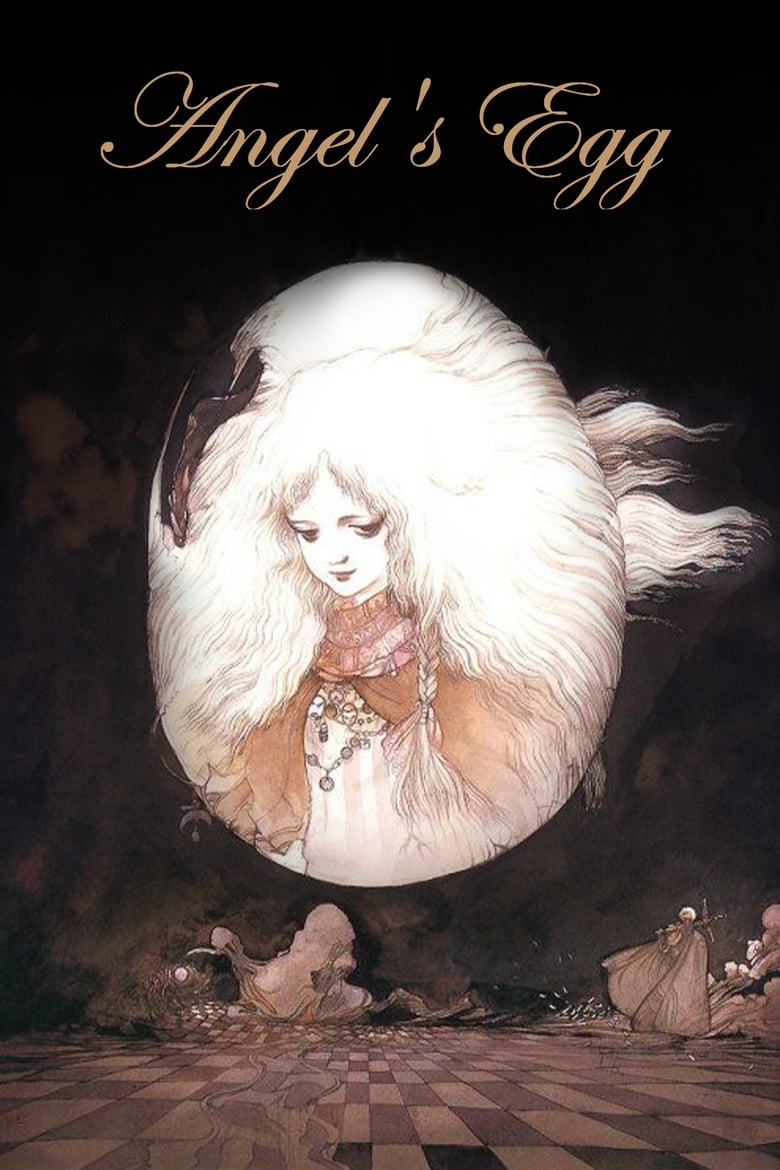
There's a version of Angel's Egg I could imagine loving. A film so committed to pure visual poetry, so uninterested in hand-holding its audience, that it becomes something genuinely transcendent. And for stretches, it nearly gets there. The problem is that "nearly" is doing an enormous amount of heavy lifting.
Mamoru Oshii, who'd later give us the equally philosophical but far more gripping Ghost in the Shell, made this as something closer to an animated installation piece than a conventional film. The character design and backgrounds come from Yoshitaka Amano, the artist best known for his Final Fantasy work, and his fingerprints are all over every frame. There's a decayed grandeur to the world here: crumbling Gothic architecture rising out of perpetual twilight, flooded streets reflecting pale light, a landscape that feels like it's been abandoned by God and hasn't quite worked out what to do with itself since. It's genuinely stunning. I sat with my jaw slightly slack through more than a few sequences, just marvelling at the sheer craft of it.
The setup, such as it is, involves a silent girl who carries a large egg with the kind of solemn devotion usually reserved for religious relics, and a wandering soldier who materialises from the gloom to question her, and existence, and faith, and everything else you might turn over in your head at three in the morning. Dialogue is sparse to the point of near-absence, and when characters do speak, it's in cryptic monologues that circle ideas about myth and belief without ever quite landing anywhere. The soundtrack is sparse and ethereal, sitting just beneath the surface like a half-remembered dream you can't shake.
Here's where my admiration starts to curdle, though. There's a difference between a film that earns its silence and a film that mistakes silence for depth. Angel's Egg too often feels like the latter. Without a single emotional anchor, without a character I could follow into the void, I found myself admiring the craft while simultaneously drifting away from it. The philosophical questions it raises about faith, existence, the nature of hope, are genuinely interesting questions. But posing them through ninety minutes of slow walks through empty corridors isn't the same as engaging with them. It's more like scrawling them on a beautiful wall and walking away.
I'm aware that some people will read that as the whole point. That the emptiness is the meaning. And look, I'll grant that the film's obsessions with hollow rituals and objects that may or may not contain anything inside them do work as a consistent metaphor. There's an argument to be made that the bafflement is intentional and thematically coherent. I just think that argument, however clever, doesn't make the experience of watching any less frustrating.
It brought to mind Blue (1993), Derek Jarman's film that reduces cinema to almost nothing, a single colour and a voice. That film similarly asks you to surrender to pure sensation over story. But Jarman gives you his own dying voice as an emotional lifeline. Oshii gives you gorgeous imagery and then steps back with his arms folded, watching to see what you make of it.
I don't think Angel's Egg is a bad film, exactly. It's more that it's a beautiful, sealed object, impressive to hold but impossible to open. If you're drawn to avant-garde animation and don't need narrative momentum to sustain your interest, there's a real chance this becomes something you return to and find new things in each time. For the rest of us, it's a film you admire like a painting in a gallery: you stand before it, you feel its weight, and then you move on slightly puzzled and slightly hollow yourself.
Two and a half stars. Mesmerising and maddening in roughly equal measure.
Rating: ★★½ | Year: 1985 | Watched: 2026-04-16
Where to watch
Watch in the US
Stream: HBO Max Amazon Channel · HBO Max
Physical: Amazon US
Affiliate disclosure: Movies With Macca may earn a small commission on purchases or subscriptions started via these links. It costs you nothing extra.
Related on Movies With Macca
More from Mamoru Oshii: Ghost in the Shell (1995)
More from Japan: Mononoke the Movie: The Phantom in the Rain (2024) · Mononoke the Movie: Chapter II - The Ashes of Rage (2025) · Blue (1993) · The Ghost of Yotsuya (1959)
More from the 1980s: Nightmare City (1980) · A Better Tomorrow (1986) · Style Wars (1983) · Garlic Is as Good as Ten Mothers (1980)
More animation: Fantastic Planet (1973) · Alice in Wonderland (1951) · Mononoke the Movie: The Phantom in the Rain (2024) · Mononoke the Movie: Chapter II - The Ashes of Rage (2025)
More fantasy: Viy (1967) · Alice in Wonderland (1951) · Mononoke the Movie: The Phantom in the Rain (2024) · Mononoke the Movie: Chapter II - The Ashes of Rage (2025)